On St. Valentine’s Day, a group of young women gathered at a busy café to listen to a Catholic nun talk about vocation, celibacy and her relationship with Jesus Christ.
Sister Agnes of the Community of the Franciscan Sisters of the Renewal (CFR) had traveled back to her hometown of Jacksonville to meet with a discernment group and share how she had chosen her vocation of serving the poorest of the poor.
It’s hard to not notice Sister Agnes. She stood out from the other customers with her grey floor-length tunic and a black veil covering her hair. The religious habit is considered a wedding dress, an outward sign of her vows to obedience, chastity and poverty.
“I never thought of religious life as a young person,” Sister Agnes said. “I had a misunderstanding of a sister. I had a stereotype that you became a sister if you couldn’t get married, which is terrible.”
Sister Agnes now considers herself a Bride of Christ.
This essay was originally published on the UI Women’s Center blog. My comment on chromosomes was not allowed in the original publication.
Writing for this blog has opened me up to new thoughts and ideas. I am challenged to think critically about the issues surrounding women and humanity as a whole. I am a believer that in order to find solutions to problems, definitions are needed. What is woman? I told myself, “I know what it is to be a woman, at least I know that I am one.” Besides confirming my gender by my XX chromosomes, I wanted to know what it means to be a woman from a philosophical point of view.
I recently went to a lecture about the nature of woman and was introduced to the works of Dr. Edith Stein. She was an early 20th century philosopher whose research focused on women, empathy, and “feminine” traits. As I researched her life and read her lectures, I found the explanation to what I hadn’t been able to put into words before.
The Jew, the Atheist, and the Believer
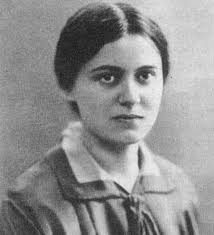
Stein as a young women
Stein was born in in 1891 in Breslua, Germany, which is now in modern-day Poland. She was the youngest of eleven children and her parents were devout Jews. She was very close to her mother and was considered her favourite. Life circumstances, including the death of her father, led her to become an atheist by her teens. “I consciously decided, of my own volition, to give up praying.”
Stein was academically brilliant, studying German and history at University of Breslua, and later philosophy at Gottingen University. She was particularly interested in women’s issues and was a self-described radical suffragette. The subject of women in a professional setting and religious living became her focus later on in life. In 1915, she served as a nurse in WWI, where she was deeply disturbed by the sickness and death she witnessed. After a year, Stein returned to school and earned her doctorate summa cum laude with her thesis “The Problem of Empathy.” Read more


 Vicky Diloné